Popular Posts


St. Agatha’s celebration is the most important religious feast in the city of Catania. It is celebrated in honor of the patron saint of the city, and, just for the number of people which involves and attracts, it is one of the world’s most popular catholic religious feasts,. It takes place every year from 3th to 5th February, 12th February and 17th August.
The recurrence of February is related to the martyrdom of St. Agatha, while the August date remembers the return to Catania of her remains, after they had been stolen and taken to Constantinople by the byzantine general Giorgio Maniace, as a booty of war, where they remained for 86 years. From 3th to 5th February, more than one million, faithful and tourists, arrive to Catania to be among the citizens for celebrating the Saint.
History
Historical origins
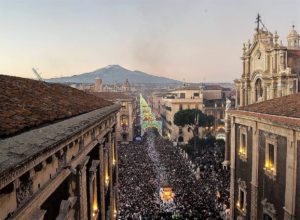
Agate was born from a family of noble Cathaneans of christian religion, around 230 A.C.. At that time Catania was under the Roman domination that barbarously persecuted anyone who professed Christianity, for which, the family of Agata, like the whole christian community, lived faith in silence. In spite of the difficulties, Agata decided, as a young woman, to devote herself to God. In the years between 250 and 251 A.C, became proconsul of the city, Quirino, who came to the headquarters of Catania with the intention of enforcing the edict of the emperor.
Known by the young girl, Quirino seems to became infatueted with her,and, having learned of the consecration, ordered her to deny her faith and to worship the pagan gods. It is more plausible that Quirino’s realities were more concerned with the confiscation of the assets belonging to the wealthy Agata’s family. At the refusal of Agata, Quirino decided to entrust her to the Aphrodite courtesan, in order to corrupt her spirit and faith with material flatteries. But, in the attempts of the controversial courtesan, Agata always opposed an unrestrained faith in God, so that, Aphrodisiah herself, renounced her assignment by sending the young woman into the hands of the proconsul.
Quirino started a trial and summoned Agata to the pretory palace. Tradition still retains the dialogues between the young woman and the proconsul, from which is evicted. the young girl’s ability to hold on to who was judging her with well-versed arguments.
From the trial to the prison the step was short.
After several days of fasting, in the face of the firmness of the young woman, physical torture began, from whipping to the tearful tear of the breasts, which, it is reported, they grew prodigiously, again, during the night, thanks to the intervention of St. Peter. The girl’s unshakable faith condemned her to the last of the tortures, a bed of embers, during which, she was told of another prodigious event: while the body of Agata was battered by fire, the red veil, symbol of her consecration to God, it was not burning. After the agony, Agata died in prison on February 5th 251
Her body was embalmed and wrapped in a red veil that, the history goes that, stopped several times the lava which threatened the city, as it was at an exact year since her death. Following these miraculous prodigies, Agata was proclaimed Holy. Originally buried in the Christian catacombs of the hill of San Domenico, after the Edict of Constantine of 313, the body of the Saint was brought to the Church of St. Mary of Bethlehem. Between the 4th and 5th centuries the body was transferred to the Church of Sant’Agata La Vetere. The relics were then stolen and taken to Constantinople in 1040.
In 1126 two Byzantine army soldiers kidnapped them and handed them over to the bishop of Catania Maurizio in the castle of Aci. On August 17th, 1126, relics returned definitively to the Cathedral of Sant’Agata, Cathedral of Catania, where they are now preserved, in part within the precious silver bust (part of the skull, chest and some internal organs) and partly within the casket, also in silver (arms and hands, femurs, legs and feet, breast and veil).
Numerous precious gifts, that over the centuries, have enriched the blessed Saint’s bust,and have built, in the course of time, a treasury of inestimable value, donated, among others, by famous figures such as Queen Margherita of Savoy, Viceroy Ferdinando Acugna and Vincenzo Bellini. Among the others, the most famous is the crown that stands out on the head of the reliquary bust: a gold jewel and precious stones, donated by Riccardo Cuore di Leone during a crusade in Sicily
The Festival of Sant’Agatha
2018
Itinerary
February 3th
PROCESSION OF THE LUMINAIA OFFER OF THE WAX
The religious celebrations begin on 3 February with the procession for the wax offering that starts from the Church of Sant’Agata to the Fornace in Piazza Stesicoro to reach the Cathedral in Piazza Duomo. From Palazzo degli Elefanti, seat of the Municipality, come out the two eighteenth-century “Carriages of the Senate” on board which the mayor and some members of the Council go to the church of San Biagio to bring the keys of the city to the religious authorities. This first day ends in the evening “a sira ‘o tri” in Piazza Duomo with a concert and a fireworks display


February 4th
MASS OF THE AURORA AND PROCESSING OUTSIDE THE WALLS
The celebrations continue day four with a religious service, “the religious mass of the dawn”, in the Cathedral in Piazza Duomo. Before the function, the half-body with the relics of St. Agatha is taken out of the “relic chamber” among the acclamations of the devotees. Immediately after the mass the fercolo is carried in procession for the “external tour” of the city. A long ride that will end at the first light of dawn on the 5th with the return to the Cathedral
EXIT FROM PIAZZA DUOMO
ARCHI DELLA MARINA
PIAZZA DEI MARTIRI
PIAZZA IOLANDA
PIAZZA CARLO ALBERTO
PIAZZA STESICORO
SALITA CAPPUCCINI
VIA PLEBISCITO
PIAZZA PALESTRO
SAN CRISTOFORO
CALATA DELLA MARINA


February 5th
PROCESSION INSIDE THE WALLS
Day five, in the late morning, the solemn pontifical is celebrated in the Cathedral. At 6 pm, the “internal tour” of the city begins. The fercolo goes up Via Etnea, arriving late at night at Piazza Cavour. Here the Saint stops for another awaited fireworks display after which the tour resumes down along the Via Etnea to the “cchianata (climb) i Sangiulianu “. After stopping in via Crociferi for the songs of the Benedictine nuns, the fercolo returns to the Cathedral in full day for the last farewell to the Saint.
EXIT FROM PIAZZA DUOMO
COLLEGIATA
PIAZZA STESICORO
VILLA BELLINI
VIA CARONDA
PIAZZA CAVOUR
VIA SAN GIULIANO
CANTO DELLE SUORE VIA CROCIFERI
RETURN TO PIAZZA DUOMO


How to move in the city
Metro, special ticket and extended time
During the celebration of Sant’Agata use the Metro
This is the slogan created by the Ferrovia Circumetnea to encourage the use of the subway on the occasion of the Agatine festivitiesOn the occasion of the celebrations of Sant’Agata of 2018, the Circumetnea Railway has introduced for the first time a special, express travel document, the Agata Ticket
This is an integrated ticket with a cost of 4 euros which will allow the use of the metro service from 3 to 6 February, also allowing the use of the Milo and Santa Sofia exchanger parking and the Metro Shuttle, whose working hours will coincide with that of the subway on 3, 4 and 5 February
The special ticket can be purchased only at the Nesima, GiovanniI XXIII and Stesicoro metro stations, as well as at the Fce ticket office in Catania Borgo
It is particularly convenient: in the absence of this title, in fact, for those who are not subscribers, the cheapest solution would consist of four daily tickets costing two euros each, for a total of eight euros. In this way, therefore, the savings are as much as 50%
On Saturday 3, Sunday 4 and Monday 5 February, the subway will be active with trains every ten minutes throughout the working hours, which will be extended for the occasion: Saturday 3 and Sunday 4 February until midnight and a half; Monday 5 until two o’clock the next morning
At 6:40 on Monday 5th the service will return regularly with trains every ten minutes until 15:10 and every fifteen minutes from 15:10 and until the last race from Stesicoro of 21:10
Note: In the month of February 2017, the Catania underground (then in the limited Borgo-Stesicoro structure of only 3.9 km) had almost 100,000 passengers in just three days, during the festival of Sant’Agata: a success of users that will be repeated also this year in the light of the commissioning of the Nesima-Borgo section last March
Precisely in anticipation of the large influx, the above described best frequency of the races will be guaranteed; for the occasion, moreover, the platform used at the Stesicoro station should be used to separate the incoming and outgoing user flows
INFORMATIONS ABOUT THE CELEBRATION
The feast of St. Agatha, patron saint of Catania, is one of the most beautiful patronal feast in the world, from 3 to 5 February three days of worship, devotion, folklore, traditions. On the days of the festival takes place the traditional Fair of S. Agata.
PROCESSION
Every year Catania offers its patron an extraordinary feast that can be compared to the Holy Week in Seville or the Corpus Domini in Cuzco, Peru. In those three days the city forgets everything to focus on the celebration, a mixture of devotion and folklore, which attracts up to a million people every year, among devotees and curious. The first day is reserved for candles. An evocative popular custom wants the donated candles to be as tall or heavy as the person asking for protection. The major religious, civil and military authorities participate in the procession for the collection of wax, a brief tour from the furnace to the cathedral. Two eighteenth-century carriages, which once belonged to the senate that governed the city, and eleven “candelores”, large representative candles of the guilds or crafts, are brought in the parade. This first day of celebration ends in the evening with a great show of fireworks in Piazza Duomo. The fireworks during the feast of St. Agatha, in addition to expressing the great joy of the faithful, take on a special meaning, because they remember that the patron saint, martyred on the embers, always watches over the fire of Etna and all the fires.
February 4th
is the most exciting day, because it marks the first meeting of the city with the patron saint. Already from the early hours of dawn the streets of the city are populated with “citizens”. They are devotees who wear the traditional “sack” (a votive white cloth vest down to the ankle and tied at the waist by a drawstring), a black velvet cap, white gloves and waving a white handkerchief also stretched in thick folds. It represents the nocturnal clothing worn by the people of Catania when, back in 1126, they ran to meet the relics that Gisliberto and Goselmo brought back from Constantinople. But the original nightgown, over the centuries, has also been enriched with the meaning of a penitential garment: according to some, the white cloth dress is the revisitation of a liturgical garment, the black cap would remind the ashes of which the head was covered penitents and the waist cord would represent the hair shirt. Three different keys, each kept by a different person, are necessary to open the iron gate that protects the relics in the cathedral: one is kept by the treasurer, the second is kept by the bishop, the third is kept by the prior of the chapter of the cathedral. When the third key removes the last mandate from the gate of the room where the bust is kept, and the sacello is opened, the smiling and serene face of Sant’Agata looks out from the relics chamber in the growing blaze of the faithfuls impatient to see her again. Shimmering with gold and precious gems, the bust of Saint Agatha is hoisted on the silver Renaissance fercolo, lined with red velvet, the color of the blood of martyrdom, but also the color of the kings. Before leaving the cathedral for the traditional procession along the streets of the city, Catania welcomes its patron with the solemn “Messa dell’Aurora”, celebrated by S.E. Mons. Archbishop. Among the clanging of celebration shots, the fercolo is loaded with the precious casket with relics and carried in procession through the city
The “Giro”
the procession of day 4th, lasts the whole day. The “fercolo” crosses the places of martyrdom and traces the events of the history of the “santuzza”, which intertwine with that of the city: the cathedral, the places of martyrdom, hurriedly, without stops, almost to avoid the renewal of the sad memories to the saint. A pause is also made to the “marine” from which the people of Catania, saddened and unarmed, saw the relics of the saint leaving to Constantinople. Then a stop at the plague column, which recalls the miracle performed by St. Agatha in 1743, when the city was spared from the epidemic. The “citizens” drive the fercolo among the crowd that is crowded along the streets and in the squares. Four thousand or five thousand citizens pull the heavy “car”. They all strictly wear the votive sack and, in small steps, in the crowd, drag the fercolo that, empty, weighs 17 quintals, but, weighed down by Scrigno, Bust and loaded with wax candles, it can weigh up to 30 quintals. At a cadenced rhythm and waving white handkerchiefs, they cry: “citizens, citizens, all devotees we are, citizens, Viva Saint Agatha!”, a hymn that also means: “Saint Agatha is alive”, she is alive in the crowd. The “tour” ends at deep night when the fercolo returns to the cathedral
On the Fercolo of February 5th,
the red carnations of the previous day (symbolizing martyrdom), are replaced by white ones (representing purity). Late in the morning, the papacy is celebrated in the cathedral. At sunset the second part of the procession begins, which winds through the streets of the center of Catania, also crossing the “Borgo”, the district that welcomed the refugees from Misterbianco after the 1669 eruption. The most awaited moment is the passage for the way of San Giuliano, which due to the slope is the most dangerous point of the whole procession. It represents a test of courage for the “citizens”, but is also interpreted – depending on how the “obstacle” is overcome – as a celestial sign of good or bad omen for the whole year. At dawn on day 6, the Fercolo with relics reaches Via Crociferi. It is the moment when the Saint greets the city before the conclusion of the festivities. Throughout the night, thousands of citizens in white coats defy the cold of the night, shouting “Viva Sant’Agata”, in moments full of magic and spirituality. At this point, while suddenly the atmosphere becomes silent, the angelic song of the cloistered nuns rises. The origin of the text and music is lost in the mists of time, even if a legend tells that its author was a Sicilian named Tarallo, who composed it specifically for the cloistered nuns of San Benedetto. At deep night the fireworks mark the closing of the festivities. When Catania gives back to the relics chamber, in the cathedral, the reliquary and the casket, the white bags smell of clean no more, the faces are marked by fatigue, the muscles hurt, the voice is reduced to a thin thread. But the satisfaction of having carried the body of St. Agatha in triumph through the streets of her Catania fills everyone with joy and repays those labors. It will be necessary to wait several months, the summer holiday of 17th August, or another year (the feast of February 5th), to see once again smiling the good face of the saint who was a martyr for the salvation both of faith and Catania
The Fercolo
it is a refined silver work used to carry in procession the sacred relics of the Catanese Martyr through the city streets during the days of the Agatine festivities. In 1519, Vincenzo Archifel, began the work, after enriched by ornaments by his son Antonio; over the centuries it was embellished with new decorations: the brands and the initials on the silver parts testify how over the years various workers, especially the people of Catania and Messina, took turns in the realization of the work that, over the centuries, underwent several transformations and damages, last of which, following the bombings of the Second World War, which determined the total reconstruction. In the basement below, various panels illustrate scenes from the life of the martyrdom of the Saint and the return to Catania of the relics from Constantinople; at the top of the roof, all surrounded by statuettes representing the 12 apostles, symbols linked to St. Agatha and her martyrdom, such as a crown, a lily and a palm
Candelore
the feast of St. Agatha is inseparable from the traditional parade of the “candelore”, huge candles covered with handcrafted decorations, putti in gilded wood, saints and scenes of martyrdom, flowers and flags. The candelore precede the fercolo in procession, because once, when electric lighting was lacking, they had the function of illuminating the passage to the participants in the procession. They are carried on the shoulders by a number of carriers-beareres that, depending on the weight of the candle, can vary from 4 to 12 men. The master goldsmiths of the fourteenth century had created the bust of Sant’Agata, a masterpiece of refined and precious art. But the people, always close to the patron, wanted to be present in her celebration with their own creations, works of craftsmanship that represented, in addition, associations of various categories of workers. Each of the 11 candles has a precise identity. On the shoulders of the bearers, it comes alive and lives its own uniqueness, which consists of several elements: the shape that characterizes the candle, the gait and the type of sway that is given to it, the choice of a march as a musical background
The candelore always parade in the same order. The small wax candle of Monsignor Ventimiglia opens the procession. The first large wax candle represents the inhabitants of the district of San Giuseppe La Rena and was built at the beginning of the nineteenth century. It is followed by that of the gardeners and florists, in Gothic-Venetian style. The third in order of exit is that of the fishmongers, in late-Baroque style with holy friezes and small fishes. His unmistakable pass earned the candelora the nickname of “bersagliera”. The following candle is that of the greengrocers, which instead has elegant steps and is therefore called the “Miss”. The butchers’ one is a four-tiered tower. The candelora of the pasta makers is a simple eighteenth-century candlestick without scenery. The candelora of the pizzicagnoli (grocers) and bettolieri (taverns keeper) is in liberty style, that of the bakers is the heaviest of all, adorned with great angels, and for its cadenza is called the “Mother”. The procession is closed by the candelora of the city circle of St. Agatha, which was introduced by Cardinal Dusmet. In the past, the candelore were even more numerous: there were those of the shoemakers, the confectioners, the bricklayers, up to reach, in some periods, the number of 28
TRADITIONAL SWEETS
During the holiday period, desserts linked to the tradition of the Catanese Saint could not be missed. In addition to the famous calia e simenza, present in every festival in Catania, some sweets are made for the occasion that have a reference to sant’Agata, such as the “Cassateddi di Sant’Aita” and the “Olivette”. These are characteristic and symbolic sweets related to the virgin of Catania. The cassateddi, or “Minni di Sant’Aita” refer to the breasts that were torn from the saint during the martyrs to which she was subjected, to force her to abjure her faith. The small olives, however, refer to the legend that she, chased by the men of Quinziano when she reached nearby the Palazzo pretorio, she had stopped to rest for a moment. At the same moment when she stopped, it is said, for fastening her shoes, an olive tree appeared out of nowhere and the young girl found shelter under it, and also feed on its fruits. Even today, to renew the memory of that prodigious event, it is customary to cultivate an olive tree in a flower bed near the places of martyrdom, and to consume these typical sweets made with real pasta during the holidays
THE PLACES OF CULT
THE CATHEDRAL OF SANT’AGATA – Reliquary bust of Sant’Agata di Giovanni di Bartolo (1373, chapel of the Sant’Agata Chapel) – Casket of the relics of Sant’Agata, late fifteenth / sixteenth century with remaking of the eighteenth (sacellum of the chapel of Sant’Agata)
SANT’AGATA AL CARCERE – Church that was built in front of the prison where the patron saint of the city, St. Agatha, was locked up during the trial, and brought after her martyrdom, healed by the apostle Peter and where she breathed her last breath on February 5 251 AD – Outside the prison, to the left of the current access gate, a lava stone block preserves, according to tradition, the impressed footprints of St. Agatha
CHURCH SANT’AGATA LA VETERE – Sarcophagus where the body of the young martyr is buried